
North India
Himachal Pradesh
Buddhism
Key Monastery (Key Gompa), Spiti Valley
Mountain Echoes
Architectural Marvel, Historic Legacy
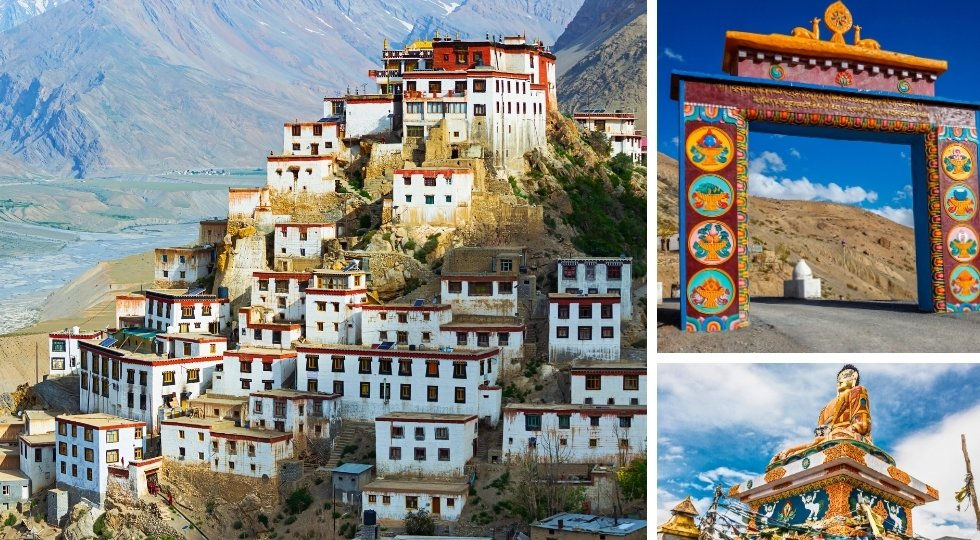
Perched dramatically above the Spiti River at around 4,100 metres, Key Monastery (Key Gompa) is the most iconic Tibetan Buddhist monastery in the Spiti Valley. Part fortress, part living monastic campus, it offers a rare mix of Himalayan scale, centuries-old Buddhist learning, and a daily rhythm that still feels genuinely intact.
THE ESSENCE
The Fortress of the Clouds
Key Gompa is one of those places where the approach itself sets the tone. The road climbs in loops above the Spiti River until the monastery suddenly appears—stacked like whitewashed cubes against a barren mountain, looking more like a defensive citadel than a religious complex.
Today, Key Monastery is closely associated with the Gelug tradition of Tibetan Buddhism and serves as a major training centre for young monks from across Spiti and neighbouring regions. Inside, it is a maze of corridors, small assembly halls, prayer rooms, and monastic quarters. The interiors are intimate and low-lit—thick walls, painted murals, and a sense that the building has expanded organically, not been planned on paper.
The visitor experience is layered. There’s the panoramic view—snow peaks in the distance, the ribbon of the river below, and villages like Kaza and Kibber sitting quietly in the high desert. Then there’s the living monastery: monks walking between classes, prayer wheels turning, and the soft hum of daily rituals that don’t feel staged for tourism.
Key is also a practical anchor in Spiti’s Buddhist landscape. Many travellers stop here early in their circuit because it helps you understand the valley: the art style, the religious vocabulary, and the deep link between monasteries and village life in this cold desert.
THE CURIO
Key’s “fortress” shape isn’t symbolic—it reflects real history. The monastery was repeatedly affected by invasions, raids, and earthquakes, and the structure evolved into a layered, defensive complex with narrow passageways and stacked rooms.
Unlike the calm, symmetrical layouts seen in many plains monasteries, Key feels like a lived-in labyrinth. Much of the building’s character comes from incremental rebuilding, meaning different corners reflect different centuries and styles.
Key is one of the best places in Spiti to notice the valley’s unique aesthetic: Tibetan Buddhist art adapted to a high-altitude desert, with earthy pigments, compact shrines, and murals designed to hold colour and meaning in low light.
If you arrive early in the day, you’re more likely to catch the monastery in “real mode”—monks attending classes or prayers—before the bulk of day-tripper traffic reaches the hill.
ANCIENT ROOTS
Founded in the 11th century (roughly 1000 CE), Key Gompa is attributed to Dromtön, a pupil of the great master Atisha. Historically, its fortress-like appearance was a necessity rather than a design choice; the monastery was repeatedly attacked by Mongol armies and later by Dogra forces. Each time it was damaged, it was rebuilt, layer upon layer, resulting in its unique conical shape. It serves as a vital archive of the Gelugpa school of Tibetan Buddhism and has remained the most important religious training centre for the people of Spiti for over a millennium.
THE JOURNEY THERE
The journey to Key Gompa is an expedition in itself.
By Air: The nearest airport is Kullu (Bhuntar), but it is still a 10-12 hour drive away.
By Road (The Adventure): * From Manali: Via the Atal Tunnel and Kunzum Pass (usually open June–October).
From Shimla: Via the Kinnaur Valley, a longer but more gradual ascent that is open year-round.Proximity: Key is located about 14km from Kaza, the main town of Spiti and is accessed by a steep hill road from Kaza via Rangrik. The drive typically takes 30–45 minutes depending on road conditions.
Local tip: Roads in Spiti can change quickly due to landslides or water crossings—always check conditions in Kaza before starting.
SACRED RHYTHMS
Key Monastery’s calendar follows Tibetan Buddhist observances. Timing can shift year to year (lunar calendar), so it’s worth checking locally in Kaza.
Gustor / Gutor (winter ritual festival):
Often associated with mask dances and ritual ceremonies in many monasteries of the region.Losar (Tibetan New Year):
Marked across Spiti with prayers and community gatherings, though the scale varies.
Even outside festival dates, daily prayers create a sense of ritual rhythm—especially in the morning.
REST & RETREAT
Key Monastery itself is typically visited as a day trip from Kaza, which offers the widest choice of accommodation in Spiti.
Kaza: best base for comfort and flexibility (hotels, homestays, cafes)
Kibber / Gette region: quieter village stays with open views
Langza / Hikkim / Komic: scenic high-village homestays (more basic, weather dependent)
Season note: In peak season (June–September), booking ahead helps—Spiti fills up faster than people expect.
PRACTICAL TIPS
Acclimatisation: This is critical. Spend at least two nights in Kaza before visiting to avoid altitude sickness.
Altitude: Key sits above 4,000m. Walk slowly, hydrate, and avoid rushing up stairs.
Clothing: Even in summer, temperatures can drop rapidly. Layers and heavy woollens are essential.
Photography: Generally allowed in the courtyards and on the roof, but often restricted inside the main prayer halls to preserve the ancient murals.
Footwear: Shoes are usually removed in certain prayer areas—watch for cues.
Do not treat it like a viewpoint-only stop: The real insight is inside—quiet halls, murals, and lived monastic routines.
THE NEIGHBOURHOOD
Key Gompa is the gateway to the high-altitude villages of Kibber and Chicham. Nearby, the Spiti River offers a stark, beautiful backdrop for walks, and the fossil-rich village of Langza is a short drive away.
If you’re visiting Key, these nearby sites fit naturally into the same day or circuit:
Komik Monastery (one of the highest villages with a monastery; distance varies by route)
Dhankar Monastery (further away but historically significant; often paired on another day)