
West India
Gujarat
Hinduism
Somnath Jyotirlinga Temple, Prabhas Patan
Coastal Whispers
Living Traditions, Historic Legacy
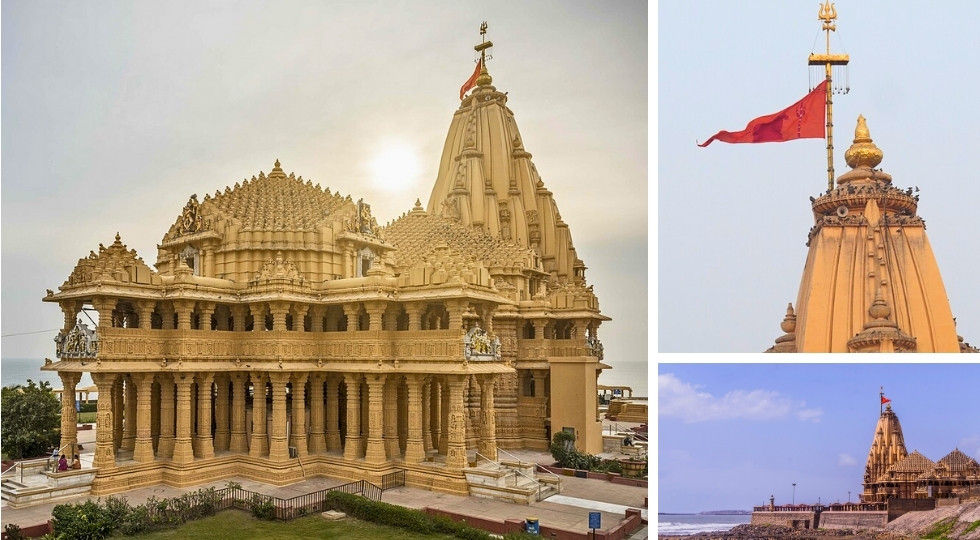
Standing at the edge of the Arabian Sea, Somnath Temple is where sacred architecture meets horizon and surf. One of the twelve Jyotirlinga shrines of Shiva, Somnath is as much about continuity as it is about belief—an active pilgrimage site shaped by cycles of destruction, rebuilding, and unwavering ritual life.
THE ESSENCE
The Unbroken Horizon
Somnath is impossible to separate from its setting. The sea is always present—visible, audible, insistent. You feel it as you approach the temple complex: salt in the air, wind off the water, and the sense that this shrine has always been oriented outward, toward the coast and beyond.
The temple is dedicated to Somnath, a form of Shiva worshipped here as a Jyotirlinga. In the Hindu sacred imagination, Somnath occupies a special place—not just as a pilgrimage destination, but as a marker of time, endurance, and faith tested by history. The site has been rebuilt multiple times over the centuries, following episodes of destruction, political change, and shifting power along India’s western seaboard.
What stands today is a modern reconstruction completed in the mid-20th century, designed in the Chalukya-style of temple architecture. For some visitors, the fact that the structure is relatively recent is surprising. But that detail misses the larger truth: Somnath’s significance has never depended solely on uninterrupted stone. It depends on continuity of worship. The rituals never truly stopped; they adapted, moved, returned.
The experience of the temple is direct and disciplined. Darshan follows a clear flow, and the atmosphere is devotional rather than theatrical. Outside, the sea-facing promenade and open spaces allow for reflection. Inside, the focus is tight—on the linga, the chants, and the shared rhythm of prayer.
Somnath also belongs to a broader coastal sacred geography. Gujarat’s western edge has long been a zone of trade, encounter, and movement. Temples like Somnath didn’t exist in isolation—they were part of port towns, pilgrim routes, and maritime worlds where religion and commerce travelled side by side.
In the evening, as the light drops and the sound of waves deepens, Somnath feels different. The crowds thin slightly, the sea grows louder, and the temple’s identity as a coastal shrine—open, exposed, and enduring—comes into sharp focus.
THE CURIO
The Baan Stambh (Arrow Pillar): A sea-facing pillar that points directly south; an inscription claims that a straight line can be drawn from this spot to the South Pole without encountering any landmass—an ancient geographical archive highlighting the temple's unique position on the Arabian Sea.
Unlike many ancient temples, Somnath’s present structure is modern, rebuilt after independence—yet it follows a long historical pattern of destruction and renewal that defines the site’s identity.
The temple’s location by the sea is not incidental; Somnath has long been linked to western maritime routes, placing it at the intersection of pilgrimage and coastal history.
ANCIENT ROOTS
The Eternal Archive
Somnath is traditionally considered the first of the twelve Jyotirlingas. While its mythological roots are Vedic, the current "Seventh Temple" was reconstructed in the Māru-Gurjara style starting in 1947. Historically, the site is a forensic record of the medieval era, having survived multiple invasions and subsequent restorations, serving as a primary archive of the region's endurance.
THE JOURNEY THERE
The temple is located in Prabhas Patan near Veraval.
By Air: Rajkot Airport or Hirasar is roughly 200km away, though Diu Airport (85km) is a closer regional option.
By Rail: Veraval Junction is the nearest major railhead, just 7km from the temple.
The Coastal Drive: The drive along the Saurashtra coast offers a rugged "Coastal Whisper" experience, with fishing villages and wind farms lining the route. Somnath is well connected by road within Gujarat and is commonly visited as part of a Saurashtra circuit (Dwarka–Somnath–Gir).
SACRED RHYTHMS
Mahashivratri: The most important annual observance; expect very large crowds and extended rituals.
Shravana month: Increased Shiva devotion and higher local footfall.
Kartik Purnima Fair: A major religious and cultural fair held on the full moon of the Kartik month (usually November).
Daily aartis: Morning and evening rituals are central to the Somnath experience.
Festival days change the energy dramatically—plan accordingly.
REST & RETREAT
Stay at the Sagar Darshan Guest House for a direct view of the Arabian Sea, or explore the various pilgrimage lodges managed by the Somnath Trust. For a more secluded stay, look at beach resorts in Diu (85km).
Many travellers also stay in Veraval or combine Somnath with coastal or wildlife travel (Gir region).
PRACTICAL TIPS
Security: Like many major Indian shrines, mobile phones and cameras are strictly prohibited inside; however, the Somnath Trust provides very efficient, free cloakrooms.
Evening Aarti: Try to attend the evening Aarti (prayer) when the drums and bells compete with the sound of the ocean waves.
Dress Code: Modest attire is required; avoid shorts or sleeveless tops.
Darshan flow: Expect queues during peak periods—move with patience.
Weather: Coastal heat and humidity can be high; evenings are more comfortable.
Time required: 60–90 minutes for darshan and a sea-facing walk.
THE NEIGHBOURHOOD
Visit the Triveni Sangam, the confluence of three holy rivers (Hiran, Kapila, and Saraswati) where they meet the sea. Nearby is the Bhalka Tirtha, the sacred spot where Lord Krishna is said to have departed the earth.
Discover more sacred places across India on our Places page.