
South India
Kerala
Islam
Thazhathangadi Juma Masjid, Kottayam
Riverine Rhythms
Architectural Marvel, Living Traditions
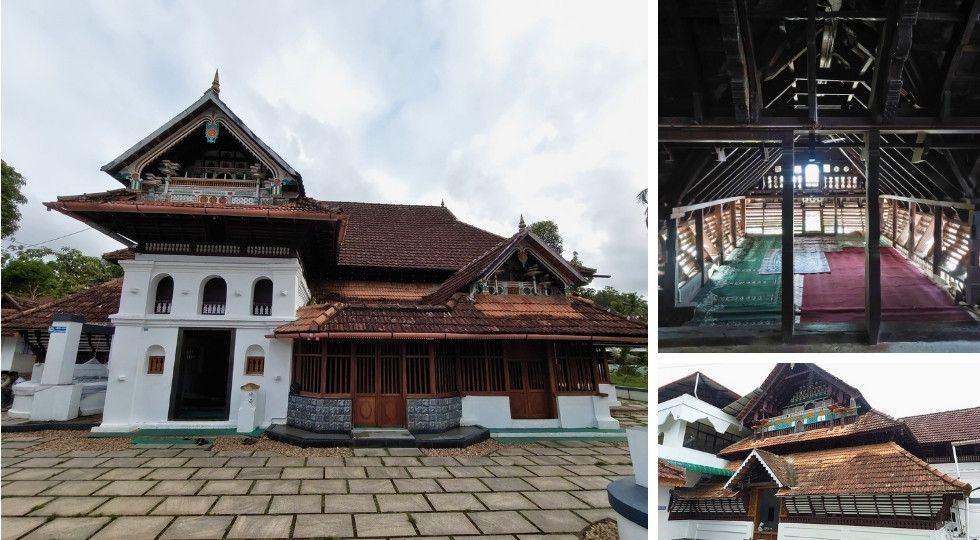
A thousand-year-old masterpiece of wooden architecture, the Thazhathangadi Mosque is a rare archive of Kerala’s indigenous Vastu Vidya, featuring intricate teak carvings and a storied past on the banks of the Meenachil River. It is one of Kerala’s most beautifully crafted mosques—quiet, richly detailed, and unlike the domed silhouettes many people associate with Islamic architecture.
THE ESSENCE
The Wood-Carved Archive
Kottayam is usually approached as a gateway—into backwaters, into central Kerala, into plantation country. But tucked into the older river-side quarter of Thazhathangadi is a shrine that belongs on any serious sacred heritage map: the Thazhathangadi Juma Masjid.
The experience begins with the setting. The Meenachil River gives this area its rhythm—boats, slow flowing water, and that distinct Kerala river-town feel where life follows the current more than the clock. The mosque sits close enough to the river that you sense the geography shaping the sacred space. It doesn’t feel isolated; it feels embedded.
Architecturally, this is a masterclass in Kerala’s wood tradition adapted to Islamic worship spaces. The roof has the familiar Kerala slope and tile profile, and inside you find richly carved wooden elements: beams, panels, and the mimbar (pulpit) that is often highlighted as one of the most intricate pieces in the mosque. The carving doesn’t feel ornamental for its own sake; it feels like devotion expressed through local craft language.
Inside, the atmosphere is cool and scented with aged teak and sandalwood. The silence is profound, broken only by the distant sound of the river. It is a "Living Archive" where Islamic calligraphy is merged with traditional Hindu temple-building techniques, creating a unique architectural vocabulary that exists nowhere else in the world. For SacredRoutesIndia, this is precisely the point: sacred places are not only about theology; they are also about how faith settles into local life and local aesthetics.
THE CURIO
The Shadow Clock (Nizhal Kadikaram): A fascinating ancient sundial remains on the premises, once used by the faithful to determine prayer times by measuring the length of the sun's shadow on a carved stone.
The Vaulted Teak Ceiling: The interior prayer hall features a ceiling entirely made of teak, intricately carved with floral motifs and Quranic verses that have remained preserved for centuries without the use of nails.
The Secret Cellar: Legend speaks of an underwater passage connecting the mosque to the river, used for both security and ritual purposes in centuries past.
ANCIENT ROOTS
The Royal Bequest
Believed to have been built in the 10th Century CE by the descendants of Habib ibn Malik (who was among the first to bring Islam to India), the mosque enjoyed the patronage of the Thekkumkoor Rajas. It is a testament to the religious syncretism of Kerala, where local Hindu monarchs provided the land and timber for Islamic shrines. It serves as a vital record of the early trade relations between the Malabar Coast and the Arab world.
Historically, Thazhathangadi was an active river port and trading neighbourhood, connected to the broader network of Muslim traders and communities in Kerala. The Juma Masjid here is traditionally considered one of the important early mosques of the region (often associated with the period of the 16th century).
THE JOURNEY THERE
Town/City: Kottayam
Nearest Railway Station: Kottayam Railway Station (approx. 3–5 km)
Nearest Airport: Cochin International Airport (approx. 85–95 km)
By Road:
Thazhathangadi is within Kottayam town limits and easily reachable by auto/taxi. Roads can be narrow in older quarters.
Local tip: Combine the visit with a short river-side walk—this shrine makes most sense when you also feel the river rhythm around it.
SACRED RHYTHMS
The Call to Prayer: The Azaan echoing over the Meenachil River provides a hauntingly beautiful sonic rhythm to the neighbourhood.
Friday Congregation: The mosque is at its most vibrant during the Friday afternoon prayers, though it maintains a dignified, quiet grace for visitors throughout the week.
Ramadan: Increased evening activity and community gatherings.
Eid al-Fitr and Eid al-Adha: Large congregational prayers and heightened devotional atmosphere.
REST & RETREAT
Kottayam has plenty of stay options:
business hotels
mid-range family stays
homestays connected to backwater/plantation circuits
This shrine is easy to include even as a short stop if you’re travelling between Kumarakom–Kottayam–Thekkady routes.
PRACTICAL TIPS
Dress: Modest attire required; cover shoulders and knees; women may be required to cover their heads to enter certain areas.
Prayer times: Visit outside prayer hours to avoid disruption (especially Friday midday).
Photography: Ask before photographing indoors; restrictions may apply.
Footwear: Remove footwear before entering designated areas.
Respect the space: Keep voices low and avoid entering prayer zones during active worship.
THE NEIGHBOURHOOD
Explore the Thazhathangadi Heritage Street to see the "Illams" (traditional houses). Also nearby are the Kottayam Cheriapally (an ancient Syrian Christian church) and the Thirunakkara Mahadeva Temple, forming a unique "Sacred Triangle" of three faiths within a 5km radius.