
North India
Ladakh (UT)
Buddhism
Thiksey Monastery, Thiksey Gompa, Leh-Ladakh
Mountain Echoes
Architectural Marvel, Living Traditions
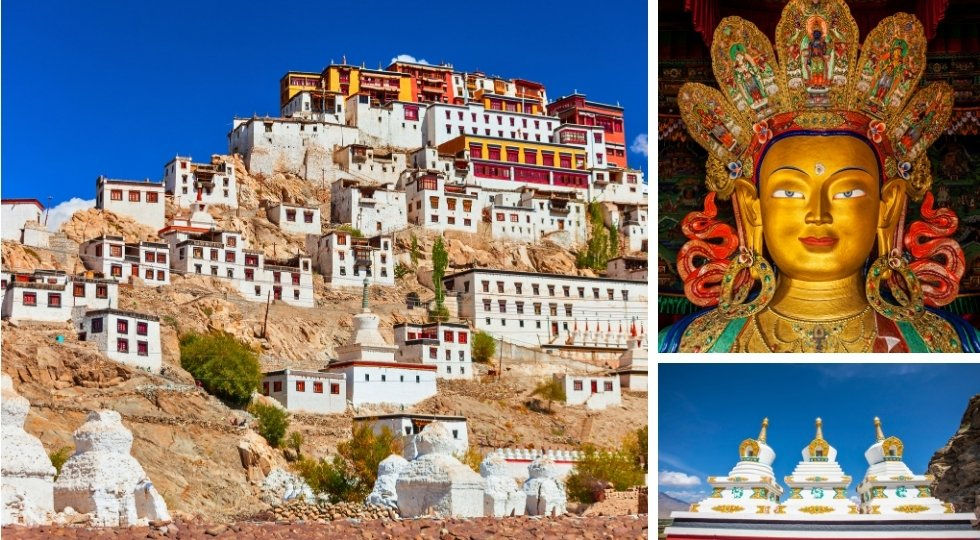
Rising tier by tier above the Indus Valley, Thiksey Monastery unfolds like a hillside village of prayer. Part monastery, part lived community, it pairs dramatic Himalayan scale with everyday monastic rhythm—chanting at dawn, study through the day, and quiet at dusk.
THE ESSENCE
The Citadel of Compassion
Approaching Thiksey, the first thing you notice is scale. Whitewashed buildings stack upward along a ridge, following the slope rather than resisting it. The monastery overlooks the broad Indus Valley, with roads, fields, and villages appearing miniature below—an immediate reminder of altitude and perspective.
Thiksey belongs to the Gelugpa order of Tibetan Buddhism and has been a centre of learning and ritual life in Ladakh for centuries. While often compared visually to Lhasa’s Potala Palace, Thiksey is not a museum piece. It is inhabited. Monks move between prayer halls, classrooms, and living quarters as part of a daily cycle that has changed little over time.
The architectural layout reinforces this rhythm. Lower levels house assembly halls and communal spaces; higher tiers contain chapels and meditation rooms. One of the monastery’s focal points is the towering Maitreya Buddha statue, whose presence dominates the interior space without excess ornamentation. Standing before the two-storey-high statue, with his serene golden face catching the thin Himalayan light, there is a sense of calm authority rather than spectacle.
Living Traditions are most evident in the mornings. Before visitors arrive, monks gather for early prayers—deep, resonant chants echoing against stone walls. Later in the day, younger monks attend lessons, elders supervise rituals, and the monastery resumes a steady, almost domestic pace. Festivals and special prayer days bring colour and crowds, but most days remain measured and quiet.
Thiksey’s significance comes from this balance. It is visually commanding, yet functionally ordinary in the best sense. Faith here is not something staged for outsiders; it is embedded in routine. The mountains amplify silence, the thin air sharpens attention, and the monastery feels like a natural extension of the ridge it occupies.
THE CURIO
The Maitreya Buddha: This 15-metre (49 ft) statue is the largest of its kind in Ladakh. It was built to commemorate the visit of the 14th Dalai Lama in 1970 and spans two floors of the monastery.
The Tara Temple: A dedicated shrine to the goddess Tara featuring 21 exquisite bronze images, serving as a rare "Architectural Marvel" of intricate metalwork.
Ancient Murals: The walls of the older chapels are covered in 15th-century frescoes that are a forensic record of the trans-Himalayan artistic exchange between Tibet, India, and Central Asia.
ANCIENT ROOTS
The Gelugpa Stronghold
Founded in the mid-15th century by Sherab Zangpo, a disciple of Je Tsongkhapa (the founder of the Gelugpa order), Thiksey became the largest gompa in central Ladakh. Historically, it functioned as a self-sufficient fortress-city, housing hundreds of monks and providing security to the valley. The architecture is a primary archive of the Tibetan Dzong style, adapted for the rugged Ladakhi terrain.
THE JOURNEY THERE
The monastery is a landmark on the Leh-Manali highway.
By Air: Kushok Bakula Rimpoche Airport (Leh) is the nearest hub, roughly 20 km away.
By Rail: There is no direct rail connectivity; the nearest major railhead is Jammu Tawi, over 700 km away.
The Approach: Located just a 30-minute drive from Leh, the monastery is best visited in the early morning to witness the prayer ceremonies.
SACRED RHYTHMS
Morning Prayers: At dawn, monks gather on the rooftop to blow the Kangling (trumpets), their sound echoing across the Indus Valley—the quintessential "Mountain Echo."
Thiksey Gustor: The annual two-day festival (usually in October/November) featuring sacred Cham dances and the symbolic destruction of evil.
REST & RETREAT
Stay at the monastery guest house for an immersive experience, or choose from various boutique eco-resorts in the Thiksey village that offer stunning views of the monastery silhouetted against the dawn sky.
Accommodation options are best found in Leh, ranging from guesthouses to boutique hotels. Staying in Leh allows easy access to multiple monasteries in the region.
PRACTICAL TIPS
Altitude: Ensure you have acclimatised in Leh for at least 48 hours before exploring the monastery’s steep stairs.
Photography: Generally allowed in the courtyards, but photography of the main deities and during prayer ceremonies is often restricted; always ask for permission.
Dress Code: Modest clothing is required; avoid shorts and sleeveless tops out of respect for the monastic community.
Silence: Maintain quiet during prayer sessions.
Time required: 45–75 minutes for a meaningful visit.
THE NEIGHBOURHOOD
Visit the nearby Shey Palace and the Stakna Monastery, which sits on a rock shaped like a tiger’s nose in the middle of the Indus River. The Indus-Zanskar Confluence is also a short drive away, offering another spectacular landscape rhythm.