
South India
Kerala
Hinduism
Thirunelli Temple, Wayanad
Forest Sanctuaries
Living Traditions, Pilgrim's Path
Set deep within the forests of the Brahmagiri hills in Wayanad, the Thirunelli Temple is an ancient Vishnu shrine where pilgrimage unfolds slowly — shaped as much by nature and silence as by ritual.
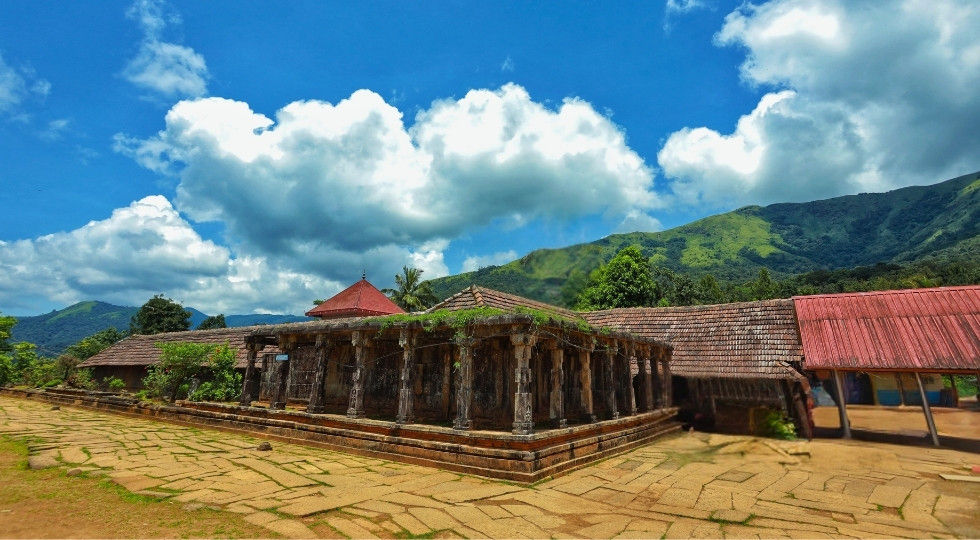
Photo: Sidhin syam kodungallur / Wikimedia Commons / CC By-SA 4.0
THE ESSENCE
The approach to Thirunelli feels less like a journey to a temple and more like a gradual withdrawal from the everyday world. Nestled close to the Kerala–Karnataka border, the temple sits within a wide clearing surrounded by forested slopes, streams, and distant ridgelines.
Dedicated to Lord Vishnu, Thirunelli is believed to be over a thousand years old and occupies a unique place in Kerala’s sacred geography. Unlike grand temple towns, there is no bustle here — only the sound of flowing water, wind through trees, and the measured rhythm of worship.
The temple is closely associated with ancestral rites. Nearby lies the Papanasini stream, where rites for departed souls are performed, based on the belief that the waters have the power to absolve sins. For many families, a visit to Thirunelli is tied not to celebration, but to remembrance — a quiet act of closure and continuity.
Architecturally, the temple follows traditional Kerala style, with a tiled roof, granite foundations, and a restrained aesthetic that blends seamlessly into its surroundings. Legends link the site to Lord Brahma, who is said to have consecrated the shrine, giving Thirunelli its enduring spiritual weight.
Thirunelli is not a place that reveals itself quickly. It asks for time — and offers stillness in return.
THE CURIO
The Granite Aqueduct: You will see a functional, ancient stone aqueduct supported by pillars that still brings water from the deep forest to the temple, a remarkable piece of ancient engineering.
The Temple of No Lights: Traditionally, the temple had no lamps lit at night, as it was believed that Brahma himself would descend to perform the final rituals of the day.
The Papanashini: The name literally means "Washer of Sins." The stream is said to possess medicinal properties due to the various forest herbs it flows over.
Thirunelli is one of the few temples in Kerala where bali and shraddha rituals for ancestors are performed outside the confines of a riverbank, relying instead on the sacred Papanasini stream. The temple is also traditionally associated with the performance of rites even for those who passed away long ago, making it a destination of intergenerational remembrance.
ANCIENT ROOTS
The Brahmagiri Archive
Thirunelli is one of the oldest temples in India, with documentary evidence in the Puranas and copper plate inscriptions dating back to the Bhaskara Ravi Varma period (10th century). Unlike many other South Indian temples that saw massive Dravidian expansions, Thirunelli has retained its classical Kerala style—small, functional, and integrated with the landscape. It was historically a vital stop for travellers crossing the mountain passes between Karnataka and Kerala, serving as a sanctuary of safety and spiritual merit for over a millennium.
THE JOURNEY THERE
The temple is located in a remote corner of North Wayanad.
By Air: Calicut (Kozhikode) International Airport is about 120km away, while Kannur International Airport is 95km away.
By Rail: Kozhikode is the nearest major railhead (105km). Thalassery is another option (90km).
By Road: * 30 km from Mananthavady (nearest town).
- 110 km from Mysore.
- 250 km from Bangalore. The drive through the Tholpetty Wildlife Sanctuary is beautiful but carries travel restrictions after dark due to elephant movements.
SACRED RHYTHMS
Bali Tharpana: The temple is most active during New Moon days (Amavasi), especially in the months of Karkidakam (July-August), when thousands arrive for ancestral rites.
Maha Shivaratri: A night of intense chanting and forest vigils.
Vishu – April
Marked with traditional rituals and modest gatherings.
The temple remains active throughout the year, with mornings being the most serene time to visit.
REST & RETREAT
There are a few forest eco-resorts and basic guesthouses near the temple. For a more comfortable stay, look for plantation homestays in Mananthavady or Kutta, which offer a quiet, immersive experience of Malabar hill life.
PRACTICAL TIPS
Timing: 5:30 AM – 12:00 PM and 5:30 PM – 8:00 PM.
Forest Safety: Do not travel the road to the temple after 6:00 PM or before 6:00 AM, as it passes through a high-conflict elephant corridor.
Photography: Permitted in the outer courtyard, but usually not inside the inner sanctum.
Modest attire is required; Footwear must be removed before entering the temple premises
THE NEIGHBOURHOOD
You are in the heart of the Brahmagiri Wildlife Sanctuary. Nearby, you can trek to Pakshipathalam, a cave deep in the forest that is home to various species of birds and bats. The Irupu Falls (across the border in Karnataka) are also connected by forest trails.